A New Competitive Boundary
A new divide is forming in the digital economy. AI capabilities are advancing, businesses are finding new ways to deploy them, and investors are funding markets that barely existed a few years ago. For leaders, the challenge is turning this movement into a practical operating advantage.
Frontier means the moving edge of what is possible. Frontier models push the limits of AI capability. Frontier organizations explore how those capabilities change work. Frontier startups develop technologies and markets that have yet to become mainstream. These meanings overlap, but each points to a different part of the transition.
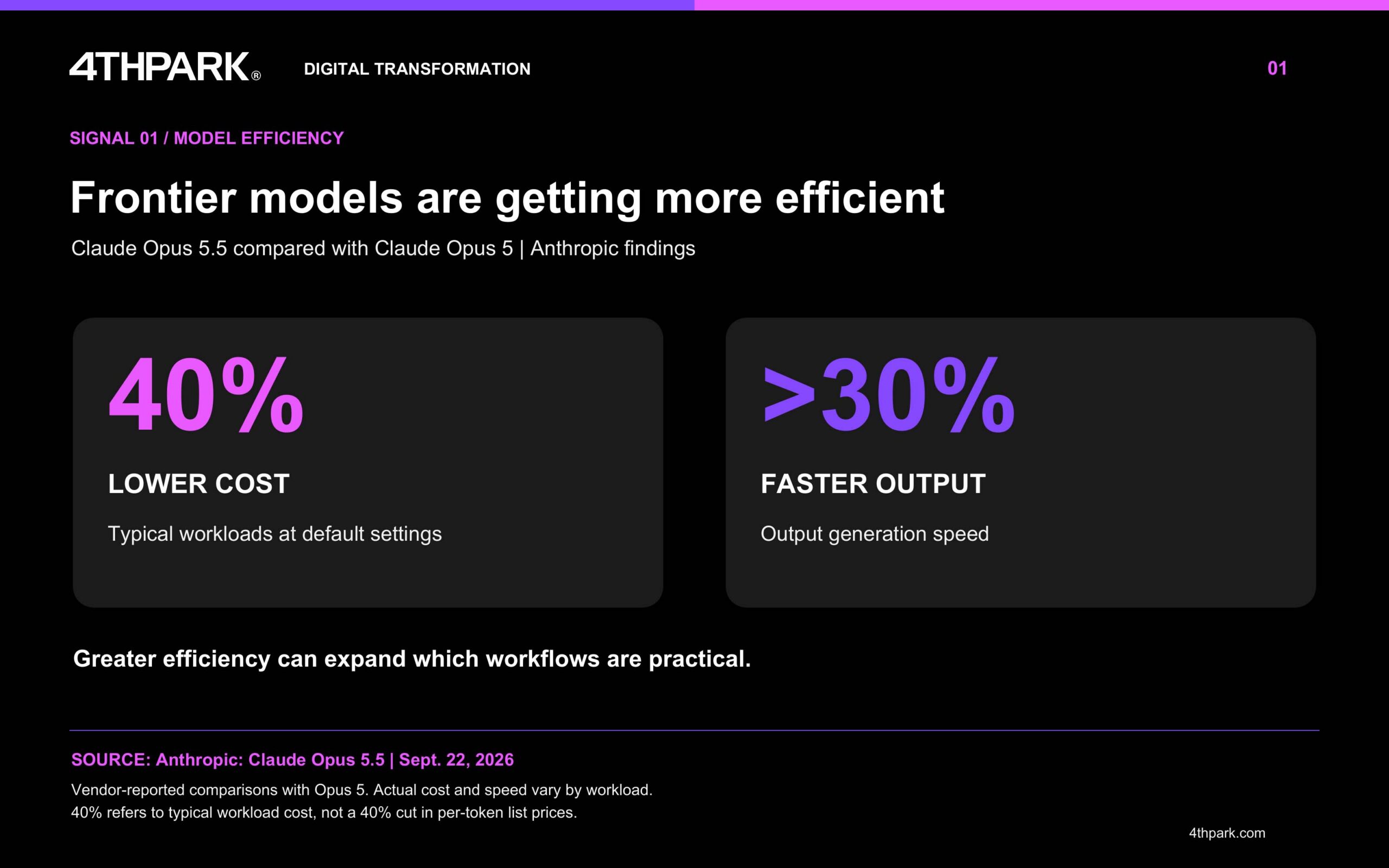
The release cycle illustrates the pace. Anthropic introduced Claude Opus 5.5 on September 22 and Sonnet 5.5 on September 28. OpenAI released GPT-6.1 Sol on September 29. These three selected launches arrived within eight calendar days. Anthropic reports that Opus 5.5 costs 40% less on typical workloads at default settings and generates output more than 30% faster than Opus 5. These vendor findings illustrate changing model economics, rather than guaranteed savings for every business. [1, 2, 3]
Our Assessment: Leaders need a repeatable way to evaluate capabilities against actual work. Model announcements alone cannot tell an organization which investment will improve service, reduce rework, or open a new revenue opportunity.
Adoption is Becoming an Operating Capability
OpenAI ranks enterprise customers monthly by output tokens per active user. Its top 10% are frontier firms; the 45th-55th percentiles are typical firms. The frontier-to-typical ratio rose from 2.6 times in January to 8.3 times in June 2026. Tokens are units of generated output, not a direct measure of profit or productivity. [4]
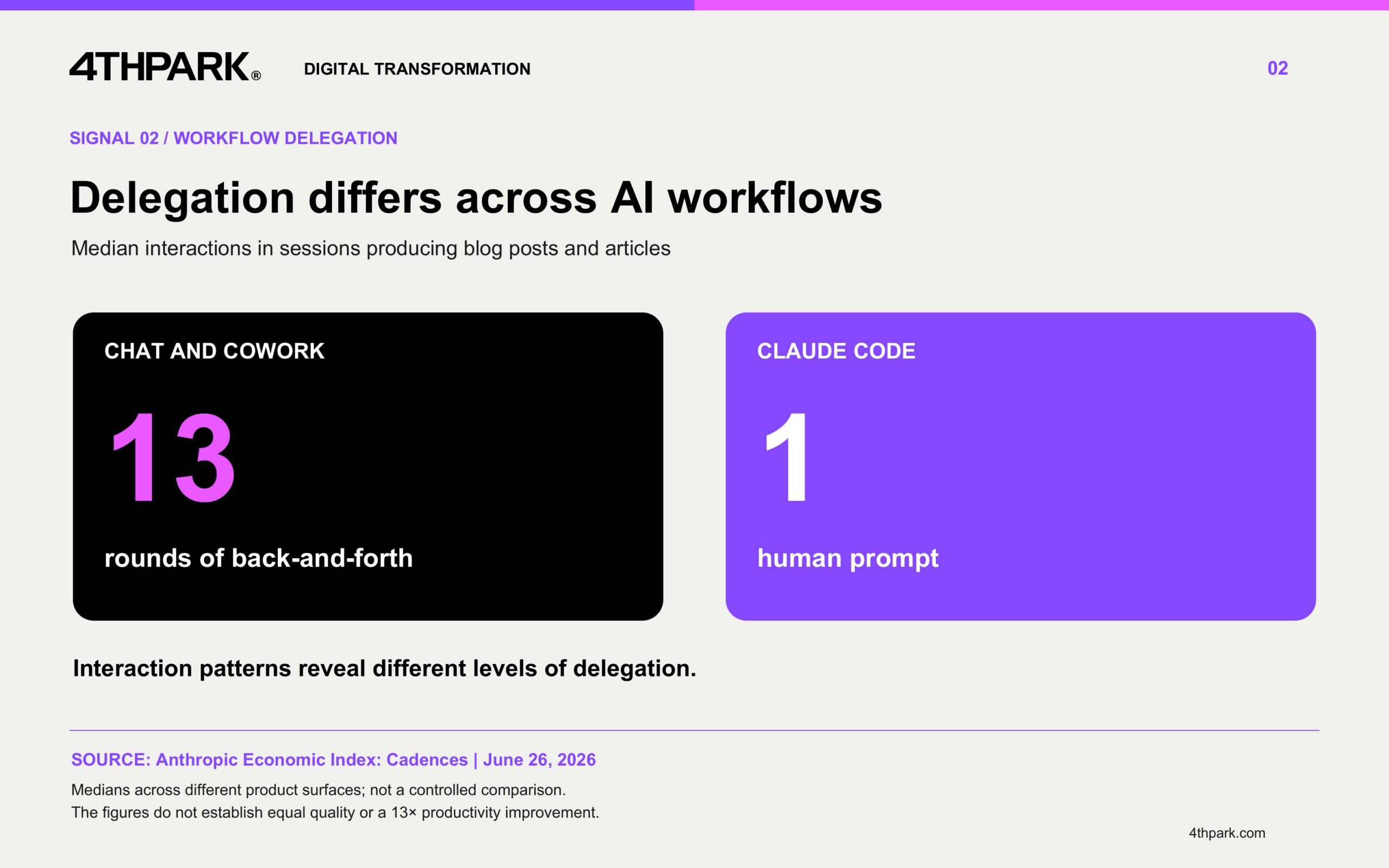
Workflow design also shapes delegation. Anthropic found that median blog and article sessions involved 13 rounds of back-and-forth in chat and Cowork, compared with one human prompt in blog-producing Claude Code sessions. This describes interaction patterns, rather than equivalent quality or a thirteenfold productivity gain. [5]
For 4THPARK®, the strategic implication is organizational. A team needs accessible knowledge, documented processes, clear ownership, and agreed standards for checking results. Consider a sales workflow: gather account history, research a prospect, prepare a proposal, and route it for approval. That requires coordination across systems and people.
We use agentic to describe workflows in which AI can carry out multiple steps toward a goal within defined permissions. AI-first means considering AI when designing the workflow, alongside human judgment, customer needs, and operating constraints.
Workers Anticipate a Larger Role for AI
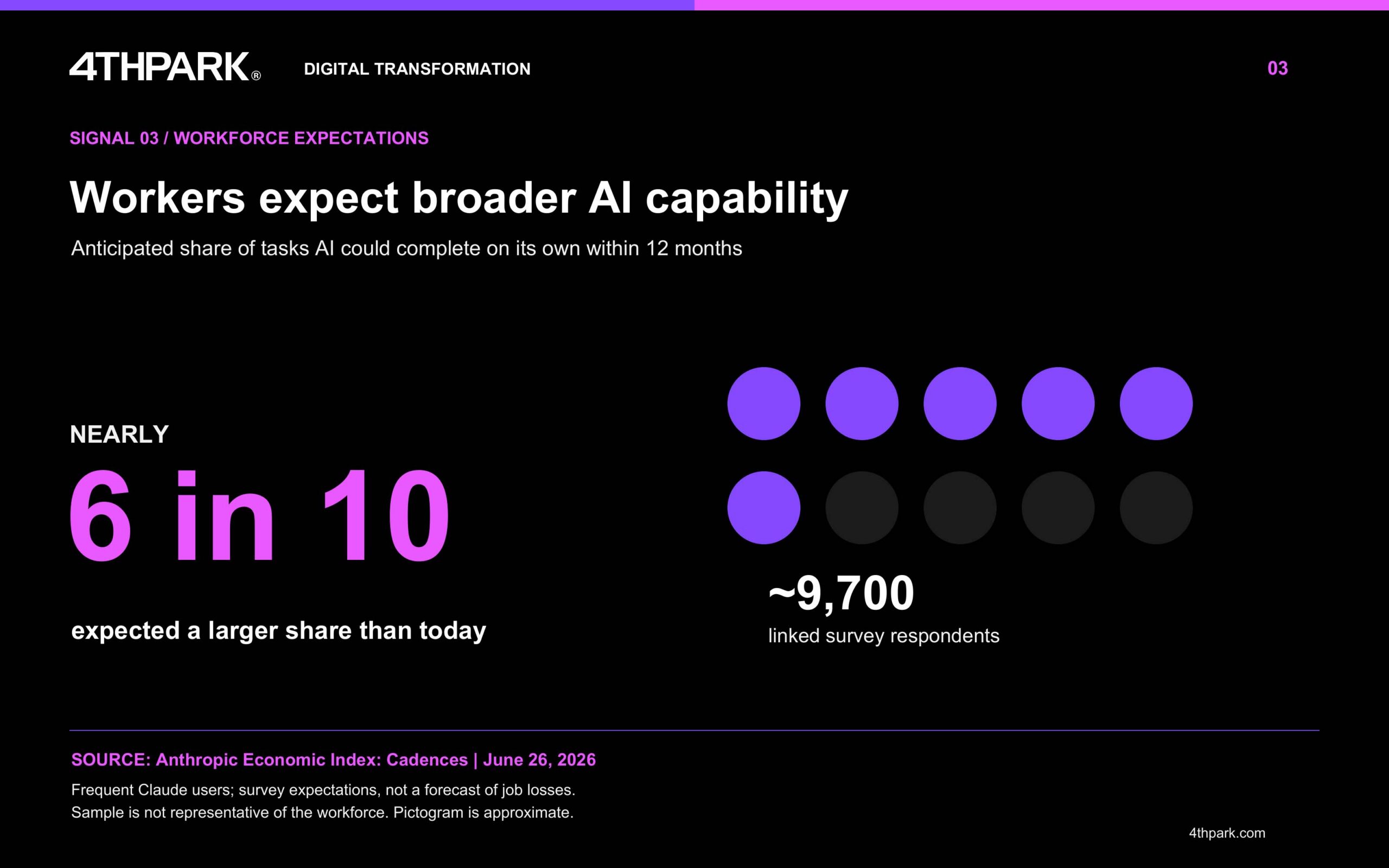
Anthropic’s June 2026 Economic Index describes a shift toward longer-running agentic tasks through Claude Code and Cowork. In its linked survey sample of approximately 9,700 frequent Claude users, nearly six in ten expected AI to handle a larger share of their tasks within twelve months. [5]
That is a measure of expectations among surveyed users. It is not a forecast of jobs lost, and the sample does not represent the entire workforce. Still, it signals that people already using these systems anticipate changes to how their work gets done.
Waiting has a learning cost. Organizations need time to identify useful applications, prepare information, train teams, and discover where automation breaks down. Those lessons come through supervised deployment and measurement.
The risk we call incremental obsolescence can emerge quietly: slower responses, duplicated effort, fragmented knowledge, and services that become harder to differentiate. Our view is that urgency should produce disciplined experimentation. Every pilot needs a business owner, an outcome, a baseline, and a review date.
For institutions supporting small and local businesses, this creates an opportunity to make adoption more accessible through shared training, workflow discovery, and implementation support. Smaller organizations can begin with a narrow process and build capability as their evidence and confidence grow.
Capital is Following the Next Market
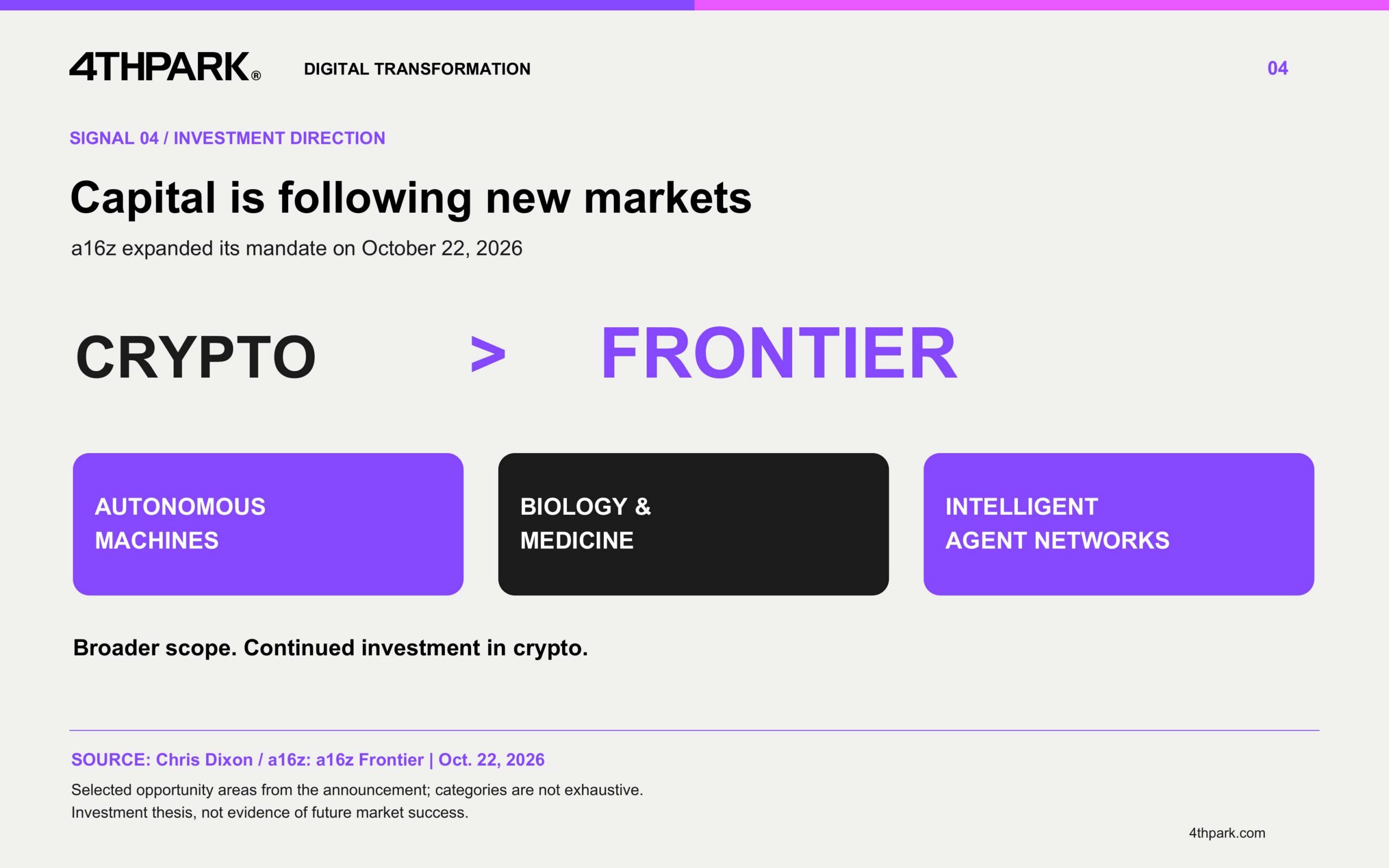
On October 22, a16z announced that a16z Crypto would become a16z Frontier, expanding its investment scope while continuing to back crypto ventures. Its stated focus includes emerging technologies and markets that could take years to develop, including autonomous machines, biology and medicine, and networks connecting intelligent agents. [6]
The announcement is an investment thesis, not proof that every proposed market will succeed. Its significance is the breadth of the opportunity: AI may improve existing operations and enable services that were previously impractical.
4THPARK® is preparing to help leaders pursue both. Our work connects Brand, Web, Content, and AI Systems so an organization’s positioning, customer experience, knowledge, and operations support the same business goals. [7]
This also changes the differentiation question. Beyond delivering an existing service faster, leaders should examine what customers could now receive that was previously too costly or difficult to provide. That is where operational improvement can become category creation.
We recommend a focused ninety-day starting point: identify one valuable workflow, document its inputs and decisions, connect approved information and tools, and launch a supervised pilot. Track turnaround time, accuracy, rework, cost per completed task, and customer impact. Expand when the evidence supports it.
Our role as a digital transformation partner is to equip leaders and teams with the strategy, systems, and support to compete as this frontier moves. What could your organization deliver if its people and systems were designed to work together with AI?
Sources
[1] Anthropic: Claude Opus 5.5. September 22, 2026.
anthropic.com/claude-opus-5-5
[2] Anthropic: Claude Sonnet 5.5. September 28, 2026.
anthropic.com/claude-sonnet-5-5
[3] OpenAI API Changelog: GPT-6.1 Sol release. September 29, 2026.
developers.openai.com/api/docs/changelog
[4] OpenAI: Enterprise Signals: What frontier firms are doing differently. Updated August 12, 2026; cited observations January-June 2026.
openai.com/signals/enterprise-data
[5] Anthropic Economic Index Report: Cadences. June 26, 2026; linked sample approximately 9,700 respondents.
anthropic.com/research/economic-index-june-2026-report
[6] Chris Dixon / a16z: a16z Frontier. October 22, 2026.
a16z.com/a16z-frontier
[7] 4THPARK®: Positioning, Expertise, & Methodology. Accessed October 22, 2026.
4thpark.com