
There’s a change in affordable housing finance right now that most people outside the industry haven’t heard of, and most people inside it are only talking about half of. It’s called the “25 Percent Test,” and if you develop, finance, or insure affordable housing at the middle-market level, it’s worth understanding. It quietly shifts risk onto your desk even though it was sold as a win.
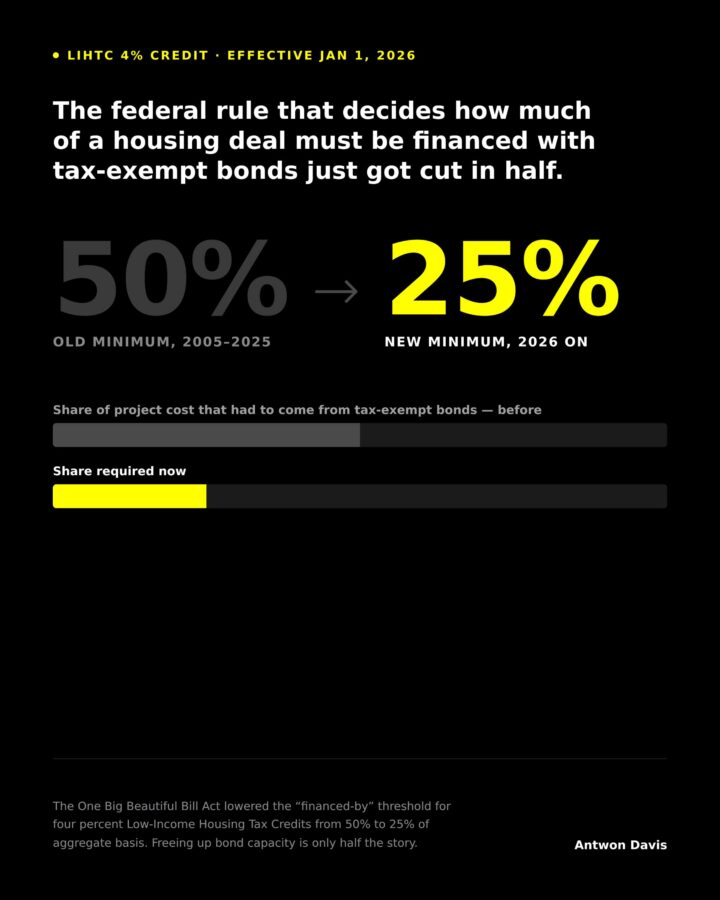
Here’s the background, kept simple. A lot of affordable housing gets built using something called the Low-Income Housing Tax Credit, or LIHTC. It’s a federal tax credit that makes these deals attractive enough for investors to fund. There are two versions of it: a bigger “9%” credit that’s competitive and capped, and a smaller “4%” credit that’s easier to access, but comes with a catch: to qualify for the 4% credit, a big chunk of the project’s cost had to be financed using a specific kind of low-cost, tax-exempt bond. For twenty years, that chunk had to be at least 50% of the project’s total cost.
That 50% requirement sounds reasonable until you realize most of these projects didn’t actually need that much debt to get built. A typical deal might only need 35% to 45% debt, total. So developers were issuing far more tax-exempt bonds than the project required, just to check a box. Multiply that across the country and you get billions of dollars a year in bond money sitting unused, money other projects could have used but couldn’t, because it was locked up satisfying an outdated rule.
The change took effect on January 1, 2026, but the precise eligibility rules matter: at least one qualifying bond issue must be dated after December 31, 2025, that issue must finance at least 5% of the project’s aggregate basis, and the building must be placed in service during a tax year beginning after 2025. Congress lowered the requirement from 50% down to 25%. On paper, that’s good news: fewer bonds get wasted, more projects can qualify for the 4% credit, and states have more room to fund additional deals. Most of the coverage on this change stops right there, treats it as a clean win, and moves on.
Here’s the part that doesn’t make headlines.
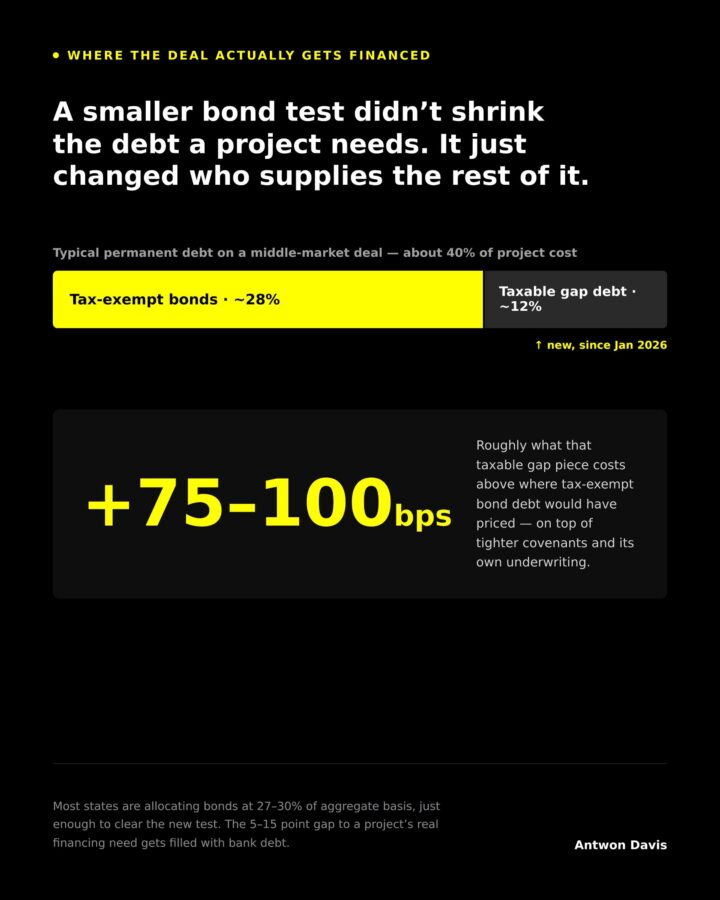
A project still needs the same amount of total debt to actually get built. That didn’t change. What changed is how much of that debt comes from the cheap, tax-exempt bonds. Before, the bond amount and the actual debt need were close to the same number, so almost the whole loan was low-cost. Now, most states are only issuing bonds equal to about 27% to 30% of a project’s cost, enough to qualify for the tax credit, but well short of the 35% to 45% the project actually needs to get financed.
That leaves a gap. And that gap has to be filled with regular, taxable debt, the kind you’d get from a bank, not a bond program. Taxable debt costs more, roughly three-quarters of a point to a full point higher in interest. On a $20 million project, that’s real money every single year, not a rounding error.
But the bigger issue isn’t the interest rate. It’s who’s now writing that loan and what they expect in return. A tax-exempt bond typically rides alongside a state housing agency’s standard requirements: predictable, government-backed, one set of rules. A bank writing that new taxable gap loan is underwriting the deal on its own terms: your track record, your builder’s insurance program, how risk is divided between you, your general contractor, and your design team, and whether your coverage actually holds up if something goes wrong mid-construction. If that picture is thin or generic, the bank prices the loan worse and adds tighter restrictions. If it’s well-documented and well-structured, that same bank has real room to compete for your business on better terms.
That’s the piece almost nobody connects back to this rule change: shrinking the bond portion of a deal automatically grows the bank-debt portion, and the bank-debt portion is exactly the part that’s most sensitive to how well your insurance and risk program is put together. Most of the industry conversation about the 25 Percent Test has stayed inside tax and bond circles. Almost none of it has reached the developers who are about to feel this in their next construction loan.
Why this matters beyond the math.
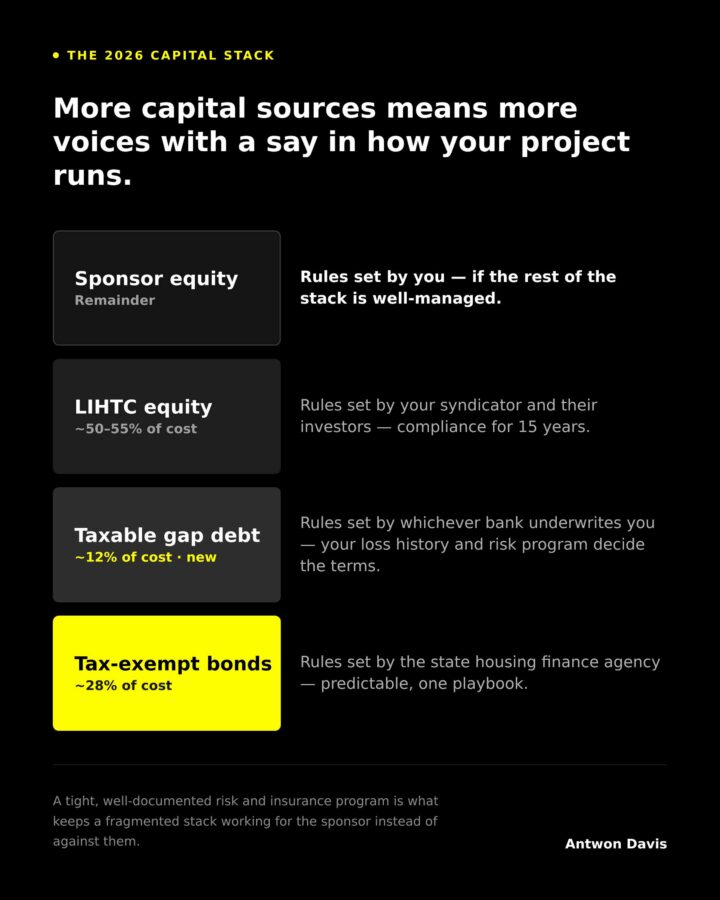
Think about what this does to control. A capital stack that’s mostly one kind of bond debt is simple. You’re mainly answering to one set of rules. A capital stack that’s part bonds, part bank debt, part investor equity, with each piece coming from a different source with its own demands, is more complicated to run. More voices get a say in how your project operates. If your risk and insurance program isn’t tight, that complexity starts running you instead of you running it. A gap in coverage becomes a loan default trigger, one lender’s requirement conflicts with another’s, and you spend your time managing your capital sources instead of managing your project.
The developers who come out ahead here won’t be the ones who found the absolute cheapest bond deal. They’ll be the ones who used this shift as a reason to tighten up their risk and insurance program, so the new bank-debt piece works in their favor at the negotiating table instead of against them. That’s not a sales pitch. It’s just what actually follows from this rule change, once you follow the math past the headline. The rule made qualifying easier. It’s on you to make sure the rest of the deal is just as solid.